
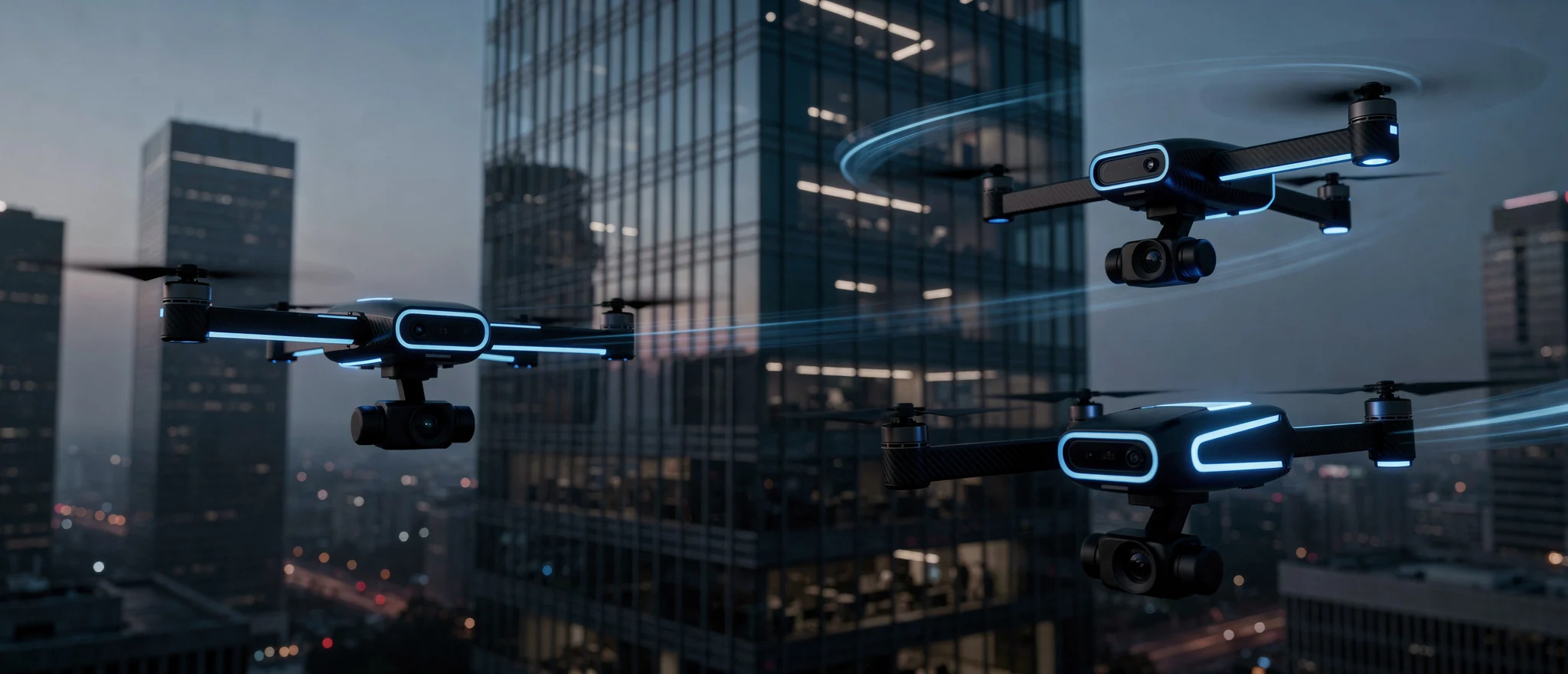
Aerial footage appears in a lot of corporate videos right now, and not always for good reason. A drone shot over a business park does not automatically make a film feel bigger or more credible. What aerial filming services genuinely add depends on the story you are telling and whether the perspective from above actually reveals something a ground-level camera cannot. Get that right, and the difference is considerable. Get it wrong, and you have expensive filler.
On this page
- What the elevated angle actually does
- Where aerial filming earns its place
- Location and property
- Events and large-scale operations
- Brand films with regional or national scope
- When to leave the drone on the ground
- Cutting aerial footage into the edit
- How long is too long
- Planning the transitions
- Planning questions to ask before you commission it
What the elevated angle actually does
Scale is the most obvious thing aerial footage communicates. If your organisation operates across a large site, a manufacturing plant, a logistics campus, or an outdoor venue, a drone shot establishes that scale in a single frame. No amount of ground-level cutting achieves the same thing as quickly.
The second thing it does is transition. A wide aerial shot of a city or a building is a natural scene-setter before you cut inside, and it signals to the viewer that location matters to this film. That is useful when geography or physical presence is part of your brand’s story.
What it does not do is add emotional depth on its own. A beautiful drone shot of your headquarters tells the viewer very little about the people inside or the work they do. That content still has to come from the rest of the film.
Where aerial filming earns its place
Location and property
If you are showing a site, a development, or a venue, aerial filming is almost always the right call. Ground-level shots of a large property cannot convey its footprint, its relationship to surrounding infrastructure, or the quality of its setting. A two-minute aerial sequence can replace ten minutes of walking tours that would otherwise feel slow and incomplete.
Events and large-scale operations
Conferences, product launches, and open-air events all benefit from an establishing aerial shot because the viewer needs to understand the crowd size or the layout before the ground-level footage makes sense. The same logic applies to logistics, construction, and energy sector films, where the operational scale is itself the message. For productions like these, aerial work integrates naturally alongside corporate video production that covers interviews, process sequences, and site detail.
Brand films with regional or national scope
If your organisation operates across multiple cities or regions and you want the film to convey that reach, aerial shots of recognisable landmarks or landscapes make the point without narration. Audiences read that visual shorthand quickly and reliably.
When to leave the drone on the ground
Office-based businesses rarely benefit. A drone shot of a standard commercial building, surrounded by other standard commercial buildings, adds nothing a ground-level exterior shot would not cover at a fraction of the cost. The footage looks like a product demonstration rather than a storytelling choice.
The same applies when budget is tight. Aerial filming requires a licensed operator, CAA permissions in many locations, and weather-dependent scheduling, so if the aerial sequence is only there to fill a gap, that money is almost always better spent on sharper scripting or stronger interviews. A well-produced promotional video built around clear messaging will outperform one with a drone shot and a weak narrative every time.
Cutting aerial footage into the edit
How long is too long
Aerial footage works hardest when it is cut with purpose. Three to five seconds of well-placed aerial footage can set a scene entirely. Fifteen seconds of the same shot, with no cut, signals that the editor ran out of material. The common mistake is letting a drone sequence run because it looks impressive in isolation, and productions fall into that trap more often than you would expect.
Planning the transitions
The transition in and out matters too. A hard cut from a drone shot to a close-up interview feels jarring unless the grade and sound design bridge them properly. This is not a reason to avoid aerial filming. It is a reason to plan it at the scripting stage rather than bolt it on in post as an afterthought.
Aerial filming at a glance, when it adds value vs. when it does not
| Situation | Does aerial filming add value? |
|---|---|
| Large site, campus or outdoor venue | Yes, scale is the message |
| Events with significant crowd or layout | Yes, as an establishing shot |
| Standard office or commercial building | Rarely, ground-level exterior usually suffices |
| Brand film with regional or national scope | Yes, as a geographic signifier |
| Interview-led internal communications film | No, the story is in the people not the place |
Planning questions to ask before you commission it
Two questions cut through most of the indecision. First, what does the viewer understand from the aerial shot that they would not understand from ground level? If there is no clear answer, the shot probably does not belong in the edit. Second, does the location or operation have visual qualities from above that are distinctive? A well-designed building, a sprawling logistics hub, or a coastal site will photograph well from altitude. A standard office park almost certainly will not.
If both answers point toward aerial filming, plan it properly from the start. Commission the drone work as part of a structured full production brief, not as an add-on decided on the shoot day. The shots that land in the edit are almost always the ones that were storyboarded weeks before the drone left the ground.