
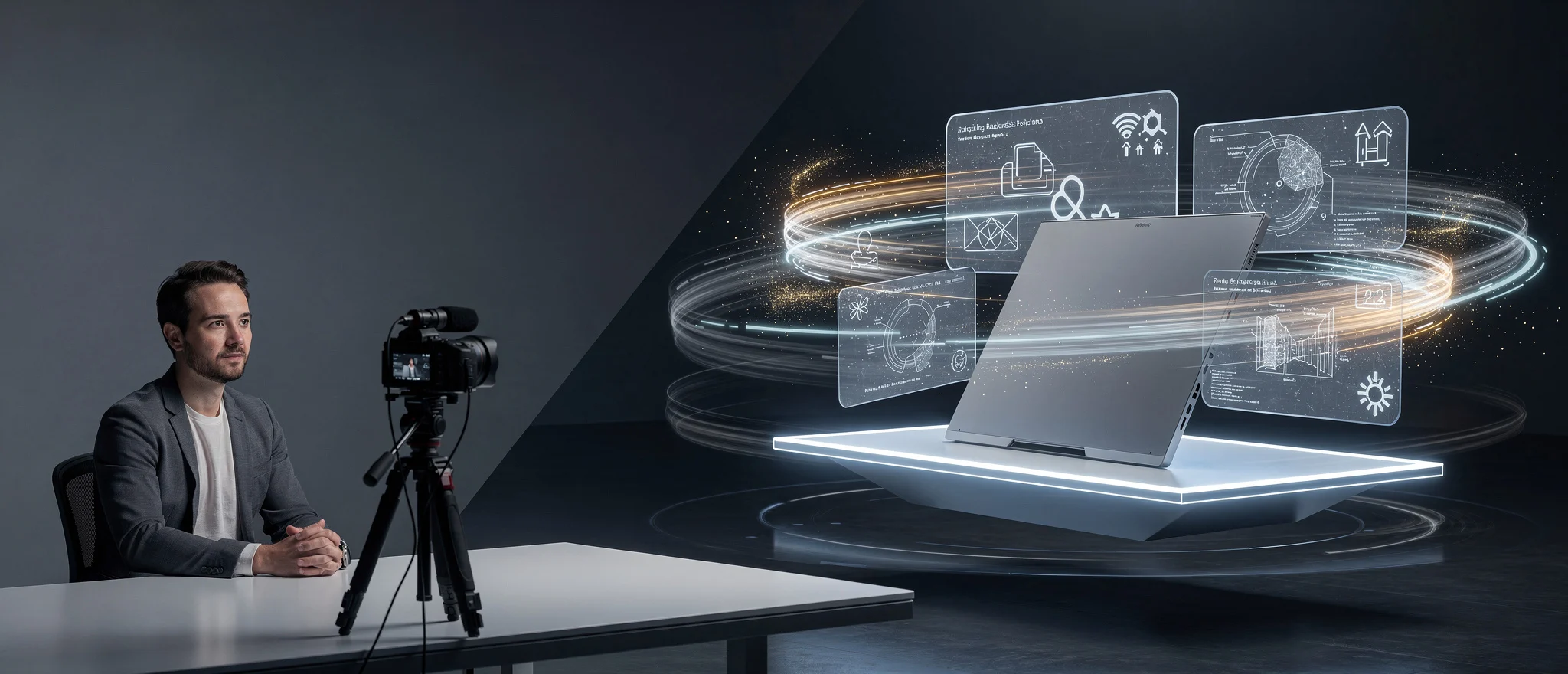
A presenter on camera is a perfectly good format for the right job. It builds personal trust, communicates warmth, and works well when the message is simple and the speaker is credible. But the moment a product has moving parts, a service delivers invisible benefits, or a process happens inside a system no camera can reach, a talking head hits a wall. That is the precise moment an animated promo video does something a presenter simply cannot.
On this page
What a Talking Head Film Can and Cannot Do
Presenter-led video earns its place in specific situations. A CEO speaking directly to camera after a company announcement carries weight a voiceover never could. A customer testimonial filmed on location feels honest. When the human connection is the message, a talking head is the right tool.
The limits appear quickly, though. A presenter standing in front of a screen or holding a product can describe a feature, but describing how that feature works internally, or why it matters to someone who has never encountered the category before, requires something beyond words and gestures. The viewer has to build the mental picture themselves, and many do not bother.
Drop-off data from video platforms consistently shows that viewers lose focus when a verbal explanation runs longer than around thirty seconds without a visual anchor. A presenter cannot change what the camera sees fast enough to hold that attention. Animation can.
How Animation Controls Attention
Motion, colour and pacing in an animated promo video are not decorative. They are directional. An animator decides exactly where the eye goes at every frame, which means no viewer accidentally stares at the wrong part of the screen while the narrator explains something critical.
Reducing cognitive load
When a viewer has to listen, watch and interpret at the same time, they carry a higher cognitive load. Animation lowers that load by synchronising the visual and the verbal. The word “connects” lands at the same moment two illustrated elements visually connect on screen. There is no gap to bridge, and the brain processes the point with less effort, which is what makes the message stick.
Pacing as a selling tool
A live-action shoot is locked to real time. A presenter explaining a three-step process takes however long it takes. Animation compresses or expands time deliberately. A complex supply chain can move from origin to destination in four seconds. A slow reveal can hold on a single benefit for three full seconds without feeling awkward, and that control over pacing is a commercial advantage, not a stylistic preference.
Selling a Complex Idea in Under 90 Seconds
The commercial case for animation is strongest when the product or service has something that cannot be filmed. Software that runs in the background, a financial process that moves between institutions, a drug that works at a cellular level, a platform that connects invisible data points. These are not edge cases. They describe a large proportion of what B2B and SaaS companies sell.
A well-built explainer video can walk a viewer through all three stages of a value proposition, problem, mechanism and outcome, in under ninety seconds, with enough visual clarity that a viewer who knew nothing about the category comes away feeling informed rather than confused. Doing that with a presenter and a camera is genuinely hard.
Consider a platform that automates invoice reconciliation across multiple currencies. A talking head can tell you it saves time. Animation can show you the invoices arriving, the system matching them in real time, and the finance team moving on to other work. The difference in comprehension is significant, and comprehension is what precedes a purchase decision.
Brand Consistency Across Every Market
Corporate buyers operating across multiple markets face a problem that single-territory businesses rarely encounter. A live-action video shot with a presenter in one country carries regional cues, accent, visual environment, cultural body language, that read differently elsewhere. Reshooting for each market is expensive and logistically difficult. Adapting it without reshooting is usually worse.
An animated promo sidesteps this entirely. The visual identity, colour palette, typography and motion style stay identical whether the film runs in London, Singapore or São Paulo. Localisation means swapping the audio track and adjusting any on-screen text. No new shoot, no talent fees, no location logistics.
For brands running global campaigns, one production budget covers every territory, and the message lands with the same force in each one.
When to Choose Animation and How to Brief It Well
Animation earns its investment when at least one of the following is true, the product has features a camera cannot show, the audience is unfamiliar with the category, or the film needs to work across multiple markets without reshoots. If none of those apply, a well-shot talking head is often the faster, cheaper and equally effective choice.
When animation is the right call, a few brief details separate a high-converting film from one that merely looks good.
- One clear outcome per film. The most common briefing mistake is asking animation to communicate everything the business does. A ninety-second film with six messages converts worse than one with a single sharp one.
- Name the viewer’s problem before the product. Animation that opens on the audience’s frustration, not the brand logo, holds attention longer and builds the case for the solution more naturally.
- Agree the call to action before the script is written. The final frame of a promo should be built backwards from what the viewer is supposed to do next. Deciding that at the edit stage means the whole film is structured around the wrong ending.
The production side of a good animated video production process handles the motion and visual craft. The brief determines whether those skills produce something that sells. Getting the brief right is the part most clients underestimate, and it costs nothing to do it properly before a frame is drawn.
So, which single outcome do you want your next promo to achieve?