
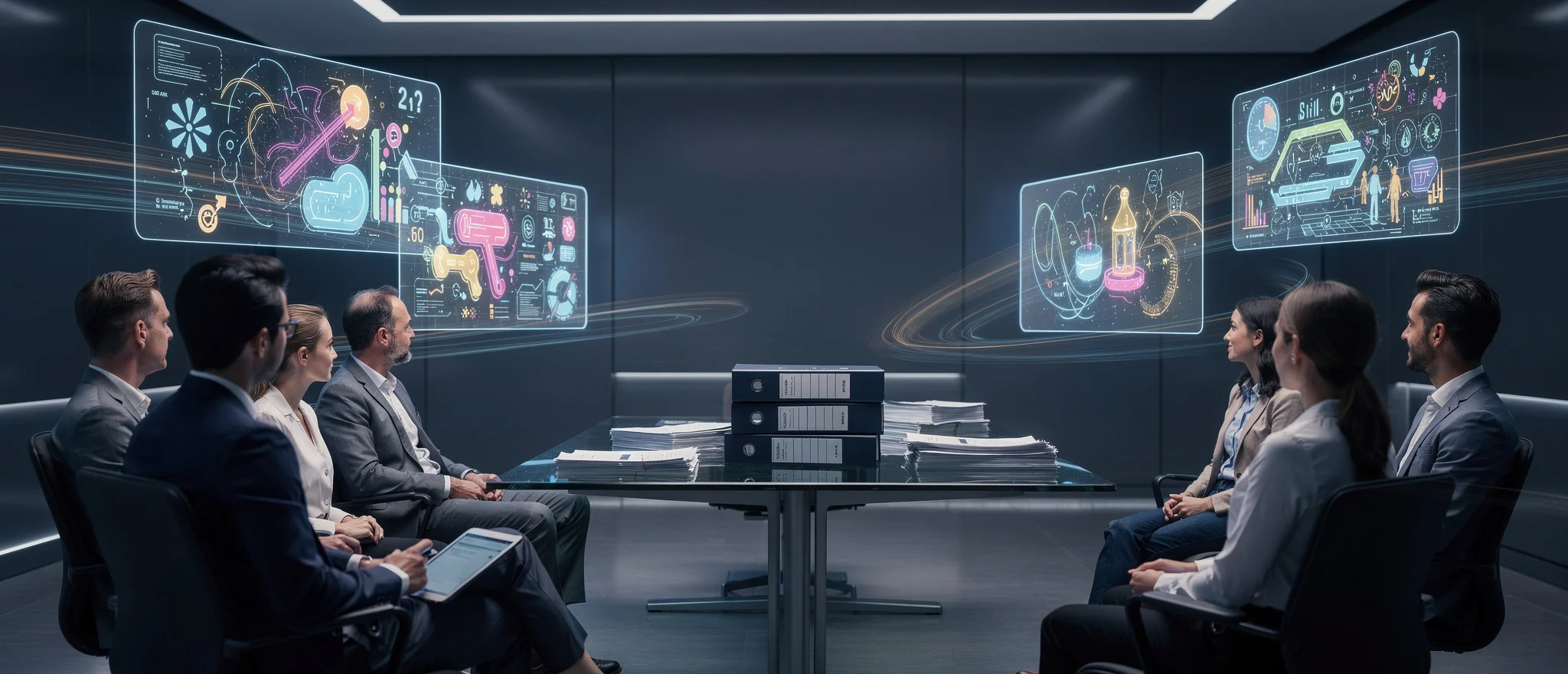
Most onboarding programmes hand new starters a folder of PDFs and a password. By the end of day one, very little of that information has stuck. The format is the problem as much as the content. Animation processes differently in the brain than dense prose does, and that difference has a direct effect on how much a new employee retains, how quickly they reach competence, and how often they come back asking questions that the handbook already answered.
On this page
- What the Brain Does Differently With Animation
- Where Text-Based Onboarding Breaks Down
- Information overload at the worst possible moment
- No signal on whether understanding happened
- What Goes Into a Good Onboarding Explainer
- When Animation Is the Wrong Choice for Onboarding
- How to Commission an Onboarding Explainer That Does Not Go Stale
- Modular scripting from the start
- Keep brand detail out of process detail
What the Brain Does Differently With Animation
When someone reads a block of text, the brain processes language through a single cognitive channel. Add a diagram or a talking-head video with no visual movement, and you have not really changed that load. Animation shifts the equation because it delivers meaning through two separate channels at once, visual motion and spoken narration, and the brain can run both in parallel without one crowding out the other.
Cognitive scientists call this dual-channel processing. A well-constructed animated explainer pairs a voiceover with motion graphics that reinforce the same idea visually, so the viewer does not have to decode written sentences and then separately build a mental picture from them. The picture is already there, moving in sync with the words.
The practical result is higher retention at first exposure. That matters enormously on day one, when a new starter is already absorbing a great deal of unfamiliar context all at once.
Where Text-Based Onboarding Breaks Down
Information overload at the worst possible moment
A new employee on their first day is already managing a lot, new faces, a new physical environment, login credentials, HR forms. Handing them a 40-page handbook at that moment is not an act of generosity. It is a transfer of anxiety. Reading requires sustained focus, and focus is in short supply when everything else is unfamiliar.
No signal on whether understanding happened
Written guides have no feedback loop. A manager cannot tell from across the room whether a new hire has understood the compliance section or simply turned the page. The assumption that reading equals understanding is baked into most text-based onboarding, and it rarely gets tested until something goes wrong.
A well-structured animated explainer video can be paired with a short follow-up quiz or a manager check-in, giving the business a real signal on comprehension rather than a ticked box.
What Goes Into a Good Onboarding Explainer
The script does most of the work. A strong onboarding explainer opens by telling the viewer exactly what they will understand by the end, moves through three or four clear beats, and closes with the one action the viewer should take next. That structure mirrors how working memory organises new information, which is why it holds.
Pacing matters more than production budget. A video that holds one idea per scene for two to three seconds before moving on will outperform a denser one with higher production values. Motion graphics should guide the eye rather than decorate it. If an arrow highlights a step in a process, the voiceover should be naming that step at precisely that moment, not a beat before or after.
Voiceover tone sets the culture. A warm, direct delivery signals that the organisation is human. A stiff, corporate read can undermine an otherwise good script before the viewer reaches the second minute.
When Animation Is the Wrong Choice for Onboarding
Not every onboarding need suits a video. Highly procedural tasks where someone needs to look up a step mid-task, such as configuring a piece of software or following a physical safety checklist, are better served by a printed reference card or a searchable knowledge base. A video paused and rewound repeatedly is a friction point, not a solution.
Compliance content that changes frequently is also a poor fit for a fully animated treatment. If the script needs updating every six months due to regulatory changes, the production cost of re-animating becomes a real burden. The smarter approach in those cases is a live-action or screen-recorded walkthrough that can be re-recorded quickly, with animation reserved for the stable conceptual content that surrounds it.
How to Commission an Onboarding Explainer That Does Not Go Stale
Modular scripting from the start
Ask the production company to treat the script in self-contained modules rather than one continuous narrative. A module covering company values should sit separately from a module covering the expense process. When the expense policy changes, only one module needs updating rather than the whole film.
Keep brand detail out of process detail
Brand-specific references, the current strapline, the CEO’s name, a campaign visual, date quickly. Process information, how to raise a support ticket, what happens in a probation review, tends to stay stable for longer. Separating them in the script means a brand refresh does not automatically trigger a full production rework.
Before signing off a treatment, ask the production team how they handle future amends. A reputable corporate video production team will have a clear answer on turnaround time and cost for a voiceover swap or a motion graphic update. If they do not, find that out before the contract is signed.
The brief itself is where longevity is won or lost. Build the video for the role, not the person currently in it. Write for the process, not the tool your team happens to use today. Those two decisions alone will extend the useful life of the finished film by years.