
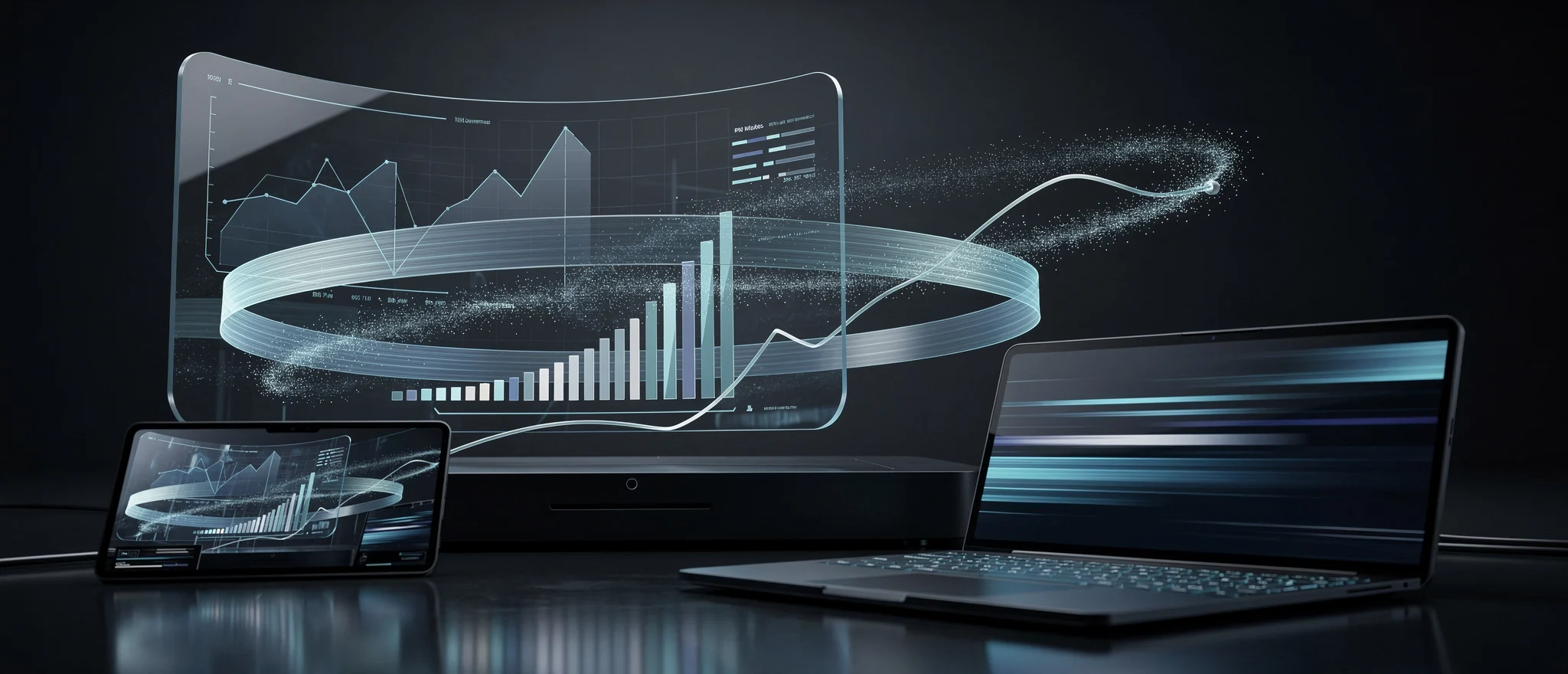
Most brands commission 3D motion graphics because they look impressive. That is not the worst reason, but it is rarely the right one. The format earns its place when the brief has a genuine problem that neither a camera nor flat animation can solve, a mechanism that cannot be filmed, a process that has no physical form, or a product that does not yet exist. Start from the communication task, not the aesthetic, and 3D becomes one of the most precise tools available to a brand.
On this page
Where 3D motion graphics earn their place
3D motion graphics are not primarily a visual effect. They are a way of showing things that cannot otherwise be shown. An insurance brand explaining how risk is pooled across a portfolio, a medical device company demonstrating what happens inside a joint after implant surgery, a SaaS platform making a data pipeline legible to a non-technical audience. These are communication problems, and 3D is often the most direct solution.
The format sustains attention in complex B2B explanations because it gives the viewer something to follow, a journey through a product, a system, a process. Static diagrams ask the audience to imagine movement. 3D shows it. That difference matters most when the subject is abstract or when the stakes of misunderstanding are high, which is exactly the territory that corporate buyers tend to occupy.
Where 3D is weaker is pure emotional storytelling. Character warmth, spontaneity, the credibility of a real face all belong to live action or, in certain contexts, to 2D character animation. Knowing that boundary is what separates a clear brief from an expensive mistake.
Where live action falls short
Cost of change
A live action shoot is fixed the moment the crew packs up. If your product changes colour, the packaging gets redesigned, or a regulator requires new on-screen text, you are back on set. With a 3D asset, many of those changes happen inside the project file, a material swap, a label update, a revised sequence. The initial production cost is higher, but the asset is more durable.
Access to the invisible
A camera cannot film inside a running turbine, show the molecular behaviour of a new adhesive, or trace the path of a signal through a network. These are exactly the scenarios where 3D character animation and motion graphics replace guesswork with clarity. Regulated industries, including pharmaceuticals, engineering, and financial services, use 3D precisely because the camera is not allowed where the story lives.
Retention in technical content
Audience drop-off in technical video tends to happen when the viewer loses the thread. A well-constructed 3D sequence keeps spatial relationships consistent throughout, so the viewer always knows where they are inside the product or process. That orientation is difficult to maintain with talking heads and stock footage cut together.
Is 3D the right call for your brief?
The honest answer depends on what you need to show, what you have to spend, and how much time you have.
3D becomes worthwhile when the subject has physical or spatial complexity that cannot be conveyed through illustration or live footage, when the asset needs a long shelf life across multiple platforms, or when precision matters more than warmth. A product launch film for a new piece of industrial equipment is a strong candidate. A recruitment video for a professional services firm is probably not.
Budget thresholds vary by studio and project scope, but 3D motion graphics sit above 2D on almost every production. If the same message can be delivered clearly through motion graphics built on flat illustration, that is the lower-risk path. Hybrid approaches, where a live action frame holds 3D product renders or data visualisations, can reduce cost while preserving the clarity that the format offers.
When to choose 3D vs the alternatives
| Brief type | Best fit | Why |
|---|---|---|
| Internal mechanism, product demo | 3D motion graphics | Camera cannot access; spatial clarity essential |
| Concept or process explanation | 2D or hybrid | Lower cost; flat illustration often sufficient |
| Brand storytelling, culture | Live action | Human credibility and warmth; 3D adds little |
| Long-shelf-life product asset | 3D motion graphics | Asset can be updated without a reshoot |
How to read a studio’s 3D reel
Render quality is the easiest thing to judge in a showreel and the least useful indicator of whether a studio will serve your brief well. Most modern rendering software produces photorealistic output at the mid-range of the market. What separates strong work from competent work is everything around the render.
Look at camera movement first. Does it serve the story, or does it move because movement is possible? Gratuitous camera spin is a reliable sign that the studio is showing off its software rather than directing the viewer’s attention. Then look at scene pacing. Does each cut arrive when the previous idea has landed, or does the edit feel rushed to fill a music track?
Lighting consistency across a sequence is also worth checking. Shadows that shift between cuts, or materials that behave differently in the same scene, point to corners being cut in the compositing stage. Good studios hold these details because a viewer’s subconscious registers inconsistency even when their conscious mind does not.
Finally, ask whether the animation itself communicates the idea or simply decorates it. If you removed the voiceover, would the visuals still tell you what the product does? That test separates narrative-driven work from visual wallpaper.
Getting the most from your brief
A studio can only build what it understands. The briefs that produce the strongest 3D work share a few consistent features, a defined audience, a single primary message, existing brand guidelines including approved colour and typography, and reference assets such as CAD files, product photography, or technical drawings where the subject has physical form.
Output format matters more in 3D than in most production disciplines because render settings are baked into the process early. A film destined for a trade show LED wall needs different specifications than a LinkedIn pre-roll. Confirm delivery formats before the studio begins modelling, not after the first draft render arrives.
For complex or multi-platform deliverables, a full-service production team handles the coordination between 3D artists, sound designers, and post-production more reliably than a single freelancer working across those disciplines alone. The brief stays consistent, the asset versions stay aligned, and the final delivery does not depend on one person’s availability. If your project spans product film, social cuts, and presentation stills from the same 3D build, that coordination is where quality is either protected or lost.