


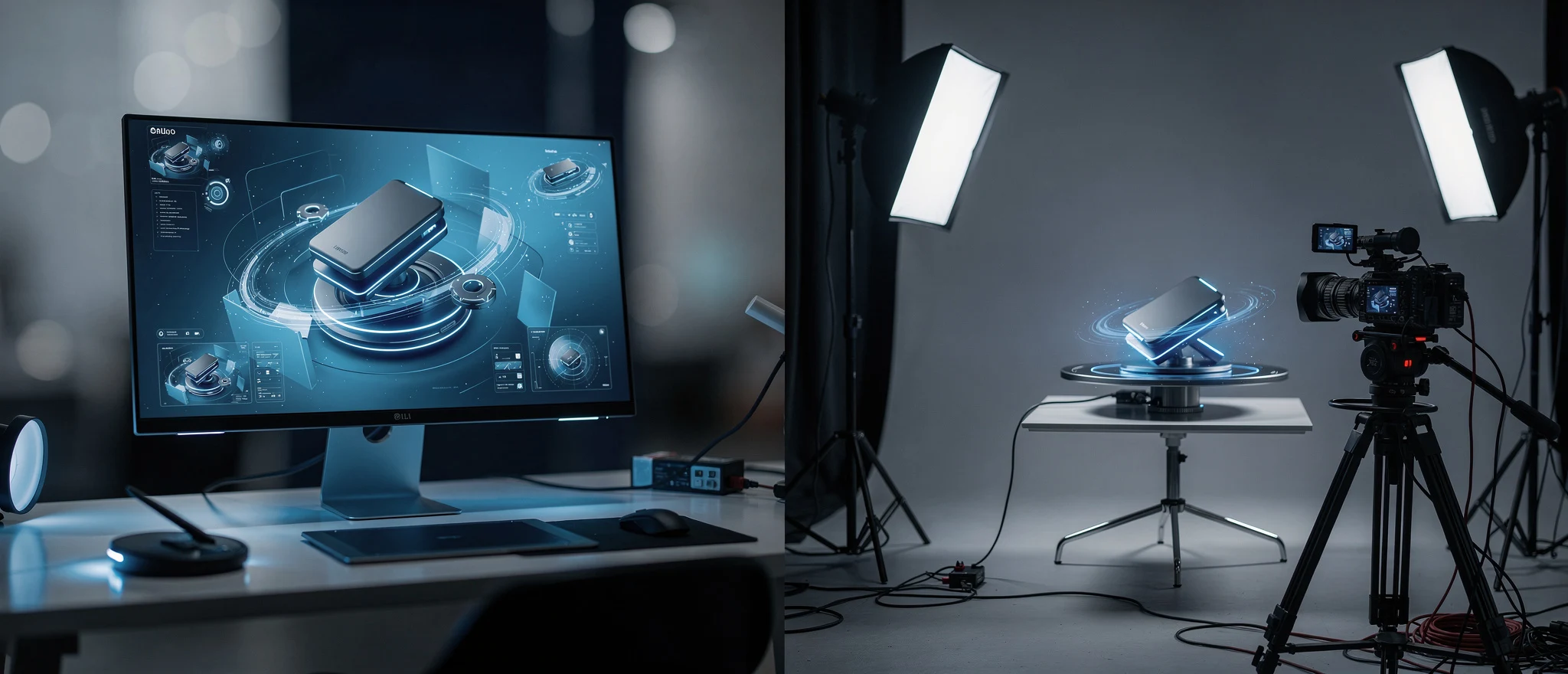
A product launch video carries a lot of weight. It has to land the value proposition, look the part, and move people to act, often in under two minutes. The question most brand managers and founders hit early is whether to shoot it live or build it in 3D animation. Both formats can do the job. The difference is knowing which one fits your product, your timeline, and what you actually need the video to do.
On this page
- What Each Format Is Good At
- When Live Action Is the Stronger Choice
- When 3D Animation Earns Its Keep
- How Budget and Timeline Play Out
- Combining Both Formats
- Where hybrid production makes sense
- The coordination it demands
- Questions to Ask Before You Commit
- Two factors most briefs ignore
- Getting the Brief Right From the Start
What Each Format Is Good At
3D animation gives you total control over the product’s environment, camera angles, materials and lighting, none of which exist in physical form until a shoot wraps. That matters most when the product itself is difficult to film. Think internal mechanisms, microscopic detail, a piece of software with no tangible form, or a prototype that hasn’t gone into production yet. A 3D render can show a car engine dismantling itself layer by layer, or place a skincare ingredient inside a cross-section of skin, without a single gram of physical set-up.
The trade-off is build time. Complex models take weeks to construct before a single frame renders, so last-minute changes to the product design can cascade into significant rework.
Live action earns its place when the product needs to feel grounded, tactile and real. A new food product photographed under controlled studio lighting, held and tasted by real people, communicates texture and appetite appeal in a way no render currently matches convincingly. It’s also the stronger format when human connection is the point, when a face reacting to a product carries more persuasive weight than any animated equivalent. The practical constraint is the opposite of animation’s. Once a shoot is complete, changing a product detail, a label colour or a key scene is expensive, sometimes prohibitively so. For promotional video work where the brief is still evolving, that rigidity matters more than most clients expect.
When Live Action Is the Stronger Choice
For products where physical texture, material quality, or sensory appeal does the selling, live action almost always outperforms any render. A skincare brand launching a new serum needs viewers to see the product’s consistency as it catches the light, the way it absorbs into real skin, the tactile cues that communicate quality before a word is spoken. Animation can approximate this, but it tends to flatten the very details that drive purchase decisions.
A promotional video built around real footage gives those details room to breathe in a way that CGI rarely matches, regardless of how polished the render is. People read authenticity quickly. If your launch depends on credibility, whether that means a healthcare professional endorsing a device, a chef demonstrating a kitchen product, or a founder speaking directly to camera, real faces and real environments do work that animation cannot replicate. A lifestyle positioning play built around aspirational real-world settings pulls an emotional response that a stylised 3D world struggles to trigger with the same sincerity. Where the product exists in a physical context that matters to the buyer, filming it there is usually the more honest and more persuasive choice.
When 3D Animation Earns Its Keep
The clearest case for animation is the product that cannot be filmed in a way that serves the audience. Internal mechanisms are invisible to any camera placed outside the casing. A medical device with a multi-stage deployment sequence, a car engine component that operates at tolerances measured in microns, a filtration system whose entire selling point sits inside a sealed chamber. None of these can be shown with live action without cutting the product open or building a costly physical cross-section. Animated product films sidestep that entirely, letting the viewer travel through walls, slow time to a fraction, and watch a mechanism operate in a way that no lens could capture from the outside.
There is also the pre-production reality that catches many brands off guard.
Launching a product before physical units exist is common, particularly where manufacturing lead times outpace marketing schedules. A photorealistic 3D render is indistinguishable from the real thing on screen, which means the campaign can go live, gather pre-orders, and build momentum while the factory is still tooling up. Beyond pure practicality, animation gives creative teams full control over lighting, environment, colour grading and camera choreography in a way no location shoot can match. For a launch that needs to look distinctive rather than merely competent, that level of control over every pixel tends to matter.
How Budget and Timeline Play Out
Live action tends to have a lower day-rate on paper, but the costs that accumulate around a shoot day are where budgets quietly stretch. Hire a studio, book a director, bring in lighting and camera crew, source props, cast talent, arrange logistics for a physical product that may not even exist yet in its final form. For an established product with a finished sample, that can move quickly. For something still in manufacturing, you are either waiting or spending money on prototypes just to have something to point a camera at.
A single location shoot for a product commercial can be turned around in two to three weeks from brief to delivery, which is fast when the brief is tight and decisions are made promptly.
3D animation sits on the other side of that equation. There are no location fees, no talent schedules to coordinate, and the product does not need to physically exist. That removes a whole layer of pre-production cost that live action almost always carries. What it does require is time. Detailed modelling, lighting, rendering and revision cycles mean four to eight weeks is a realistic window for quality work, sometimes longer for complex scenes. Where motion graphics and 3D animation pay back the investment is in reusability. Change a colour, swap a background, adapt for different markets, and the underlying asset does most of the work again without rebuilding from scratch.
Combining Both Formats
Where hybrid production makes sense
The strongest product launch films we see today often refuse to choose between the two formats. A live-action hero shot gives the product physical credibility, showing it in a real hand, a real environment, a real moment of use. Then, exactly where the camera cannot go, a 3D sequence takes over, pulling back the casing to reveal the internal mechanism, mapping airflow through a ventilation system, or scaling a microscopic component to screen size. Think of a cordless power tool filmed on a building site, cutting to a motion graphics sequence that maps the battery’s charge distribution across the motor cells. Neither format alone would carry that argument as efficiently.
The coordination it demands
Hybrid shoots require closer planning from the outset because the live-action director and the 3D team need to agree on camera angles, lighting rigs, and transition points before a single frame is captured. Misalign those decisions and the join shows, which breaks the viewer’s trust in the product itself.
When the brief is tight or the timeline compressed, a single-format approach often makes more sense. But for a considered launch where the product has a complex story to tell, the additional coordination pays for itself in a film that explains what competitors cannot show.
Questions to Ask Before You Commit
The format decision becomes much cleaner once you stop asking “what looks good?” and start asking what the content needs to do.
First, think about the product itself. If it is physical, textured, and emotionally resonant, live action tends to carry more weight because viewers need to feel its reality. If it is software, a complex mechanism, or something that doesn’t yet exist in manufacturable form, 3D animation lets you show internal workings, abstract processes, and ideal-world scenarios that no camera can capture. Then consider your distribution channels. A short-form social ad needs to cut through fast, and animation gives you total control over pacing and visual hierarchy. A retailer’s product detail page, by contrast, often benefits from live footage because shoppers are making a purchase decision and want to see the real thing.
Two factors most briefs ignore
Audience familiarity and post-launch version control are the two factors most briefs ignore until it’s too late.
If you’re launching into a technically literate audience, a precisely rendered animation signals competence. If you’re launching a consumer product to a broad, general market, real people and real environments tend to build trust more quickly. Version control is worth thinking through carefully before you shoot anything. A live action film is expensive to update if the product changes colour, adds a feature, or enters a new market requiring different messaging. An animated asset can be revised at the edit or render stage for a fraction of the original cost, which matters a great deal when a product launch rarely goes exactly to plan.
Getting the Brief Right From the Start
The format decision and the creative concept need to develop together, not in sequence. Commissioning a live action shoot and then asking a writer to build the idea around it tends to produce videos that feel constrained, as though the creative was reverse-engineered from a location. The same problem appears in reverse when a team locks in 3D animation before agreeing on the level of product detail, the tone, or the pacing, and then discovers mid-production that the brief was built for a different format entirely.
A good brief names the audience, the single action you want them to take, the emotional register you’re aiming for, and the one thing the product must visually demonstrate. Everything else flows from that.
For live action, the brief should also address environment and talent, because those choices shape cost and timeline from day one. For animated video production, the brief needs to specify how technically precise the product representation must be, since photorealistic rendering and stylised motion graphics carry very different production demands. Once those parameters are clear, the conversation with a production team becomes far more direct. You stop debating format and start making the film. Bring the brief to that first conversation as a working document, not a finished prescription, and the right format tends to declare itself quickly.